
How email signatures can drive brand awareness and organic traffic
To boost brand awareness and drive organic traffic, most companies invest in new marketing tools and expensive ad campaigns. But they often overlook one small detail that appears in every email they send—the email signature.
No surprise here. Emails feel too ordinary to be treated as a marketing channel, and signatures feel even smaller—just a name, title, logo, and contact details at the bottom of a message.
But that is exactly why they matter.
In this article, I’ll show how email signatures can become simple, affordable brand assets that reinforce recognition, guide people to useful content, and support organic traffic—with practical email signature examples along the way.
|
Quick Overview
|
1. Why email signatures still matter for brand visibility
2. What makes an email signature recognizable and click-worthy
3. Where to place links, banners, and calls to action
4. How email signatures can support organic traffic growth
5. How to measure email signature impact on traffic and awareness
Why email signatures still matter for brand visibility
In 2026, around 392.5 billion emails are expected to be sent and received every day worldwide. That number is projected to reach 408.2 billion in 2027. So, when someone says email is “old,” I’d argue the opposite: email is still one of the most stable places for repeated brand exposure.
The reason email marketing is not shrinking is that it remains a highly personal communication channel. While your brand's exposure in most modern marketing tools gets diluted across ads, feed updates, and pop-ups, email gives your brand an opportunity to appear inside a real conversation.

An email signature has three unique advantages:
- It appears at the very end
- It doesn’t ask for attention too aggressively
- It repeats in every email sent.
Because it’s the last element a recipient reads, if designed masterfully, it often becomes the most remembered element in the entire message. Yes, often subconsciously, but that’s exactly the power and the secret to its effectiveness, if you want my honest opinion.
It supports a consistent brand identity by repeating the same signals:
- Your logo
- Your brand colors
- Your job title
- Your website link.
On occasions, professional email signatures can also go one step beyond that basic info and include your latest content or marketing campaign—the best social proof of your brand.
A prospect can ignore an email signature once, two, or several times, but the repetition will do its job—and that is exactly how email signatures increase brand awareness over time. They’ll inevitably zoom in and pay attention sooner or later, and that single moment can do more for your brand visibility than a series of salesy ad campaigns.
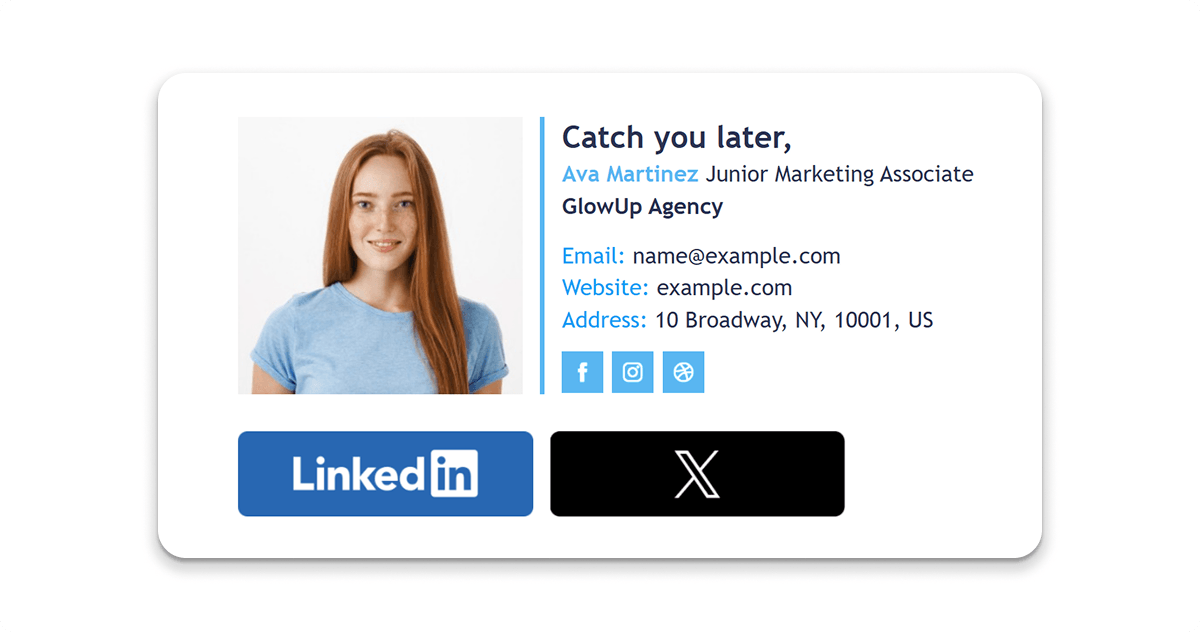
To illustrate, here are email signature examples, each effective in its own way, plus some email signature examples for small businesses worth checking out.
In the next chapter, I’ll break down what exactly makes an email signature recognizable.
What makes an email signature recognizable and click-worthy
A recognizable email signature is one that doesn’t try to accomplish everything at once. You don’t put everything into that concise format, given that the space for a signature is extremely limited. Make it longer, and it risks looking awkward, cumbersome, and unprofessional, potentially overshadowing the main text (if it’s a short email).
A click-worthy signature should be short and focused (relevant):
- Short: little is more—that’s the main recipe. You only have two to three lines of short text available, so you’d better make that space count.
- Focused, or relevant: provide the details that matter to this particular outreach purpose and recipient. For example, if you’re emailing newsletter subscribers, link to your latest guide, blog post, or resource that gives them more value after the conversation ends.

A good signature works like a business card, giving the reader a quick understanding of the three things: (1) who you are, (2) what brand you represent, and (3) where they can go next. If they need to study your signature, it is already too heavy.
The key to effective email signature branding is to maintain a balance between keeping your signature short and focused, while being informative (covering the three things mentioned above).
I’ve seen a lot of overdone email signatures, even from people who were not new to email signature marketing. Based on that, I've made my go-to list of recommendations for recognizable email signatures:
- Use the same logo across the team
- Keep colors close to your brand style
- Add one useful link, not five competing links
- Make the call to action specific
- Keep banners clean and easy to read.
💡 Pro tip: Use enough white space around each signature element. People are not machines; they need “breaks” to focus on the main stuff. This means allowing ample line spacing and separating graphical elements in your email signature by at least one line of plain text.
Where to place links, banners, and calls to action
Email signature management requires careful planning, although the signature itself is a short and focused email element. Strategy first, details (elements) and their exact location second.
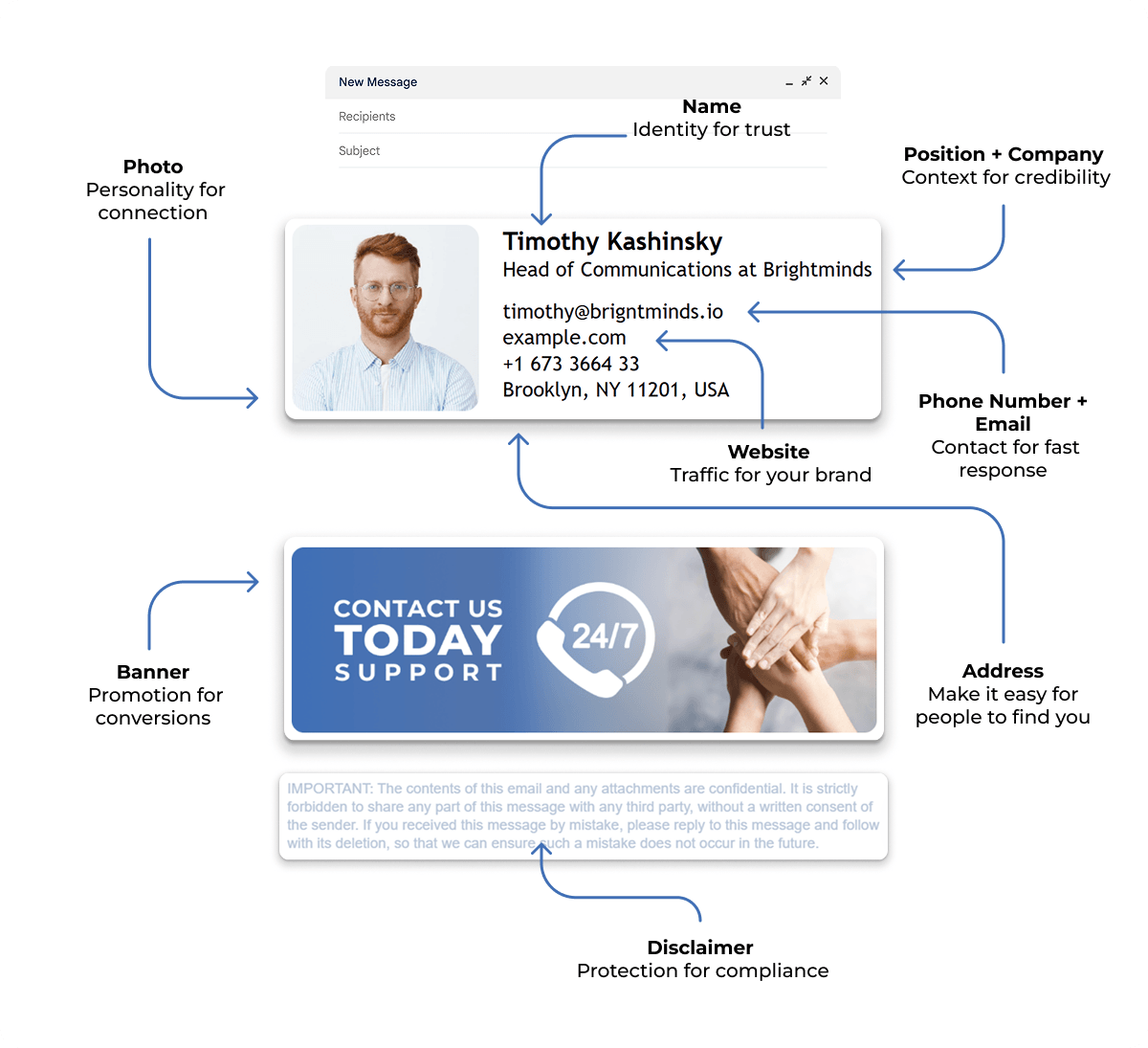
The safest structure I recommend is simple:
- Start with identity
- Add contact details
- Finish with an action.
When using email signatures for customer trust, the reader should first understand who you are and what company you represent. Only then should they see where they can go next.
The beauty and the limitation of this design of a branded email signature is that there isn’t much variability, really. These are the basic ingredients of an effective email signature. You cannot do without them, and there isn’t much space for creativity to add additional categories.
As for the signature elements, just follow these essential recommendations:
- Website link. The website link works best when it sits close to your company name or logo. It feels natural there. The reader sees the brand, then sees where to find it.
- Banners. Banners should sit below the main signature, not above it. If the banner comes first, it competes with your name and role. That makes the signature feel more like an ad than a professional sign-off, which can weaken your professional brand image.
- Call to Action (CTA). The call to action should be specific. “Visit our blog” is clear, but weak. “Read our guide to email branding” gives the reader a better reason to click.
🎯 Pro tip: Use only one primary link per signature campaign. Avoid stacking multiple links, e.g. website link plus content link. Two or more links look spammy, while one focused link points to only one clear route (next step).
Here is what I mean by an effective email signature design:
How email signatures can support organic traffic growth
A business email signature doesn’t work the same way as SEO. It doesn’t help you rank higher in search results, nor does it increase the chances for your brand to get into AI-answers.
It supports organic growth through another mechanism.
Organic growth is not only about search rankings. It is also about building regular paths to your useful pages. Your email signature can become one of those paths.
The idea is simple: professional email signatures provide readers with a personal invitation to visit something relevant on your website. It could be your main page, your landing page, a webinar recap, a case study, or a particular blog post where you describe your offer.
The main thing is that the content a user discovers is relevant. Not salesy or promotional. Just relevant and unpushy.
This mechanism works when a link you provide feels natural, not forced. Here are some examples of natural link placement situations:
- Reaching out to a potential client—a case study will naturally prove your point and convince the reader.
- Replying to a newsletter subscriber—a helpful guide can support retention and strengthen loyalty.
- Following up on a webinar—meeting notes, key takeaways, an entire presentation, or similar recap info would be most natural and appropriate.
If you are consistent and adhere to the best principles of emotional marketing, e.g., sending out emails with your signature on each appropriate occasion, engaged visitors will come and perform desired actions on your website.
This is where you’ll notice organic values start to climb up. Some from direct invitations, others from shared emails with links to your pages.
How to measure email signature impact on traffic and awareness
Famous British physicist and businessman of the 19th century, Lord Kelvin, once said: “If you cannot measure it, you cannot improve it.”
This is so true for every business metric, including brand awareness and organic traffic. You can try hard and follow our recommendations from the chapters above, but if you have no measurable feedback on your actions, you’ll be playing a guessing game.
The correct approach is to do an incremental change to your email signature, e.g., introduce a new brand logo, and then measure the results of that specific change on your brand awareness and traffic.
And the simplest way to start is by adding tracking parameters to the link in your signature. This helps you see how many visits came from that specific placement, not from email in general.
For example, you can track:
- Clicks from each signature campaign
- Visits to the promoted page
- The exact time users spend on that page (do they bounce, or do they stay?)
- Newsletter sign-ups, form submissions, or demo requests
- Returning visitors from signature traffic.
I won’t recommend measuring only clicks. They are just signals of intention, showing interest, but nothing more. You may get 100 clicks, but none of those interested would convert on your page.
⚖️ Pro tip: If you find the idea of measuring one change at a time ineffective (e.g., you think it's too slow), consider trying the so-called A/B testing. The idea is simple: you introduce two variants (variant A and variant B), and run several email disseminations to see which variant performs better. Obviously, you should leave the winner of the contest.
Here is a quick recap and an illustration of what we’ve discussed in this chapter:
The Bottom Line
Email marketing is a cost-effective way to boost organic traffic, and an email signature has a critical role to play here. It is the last thing that an attentive reader sees in your email, making it the highest-leverage touchpoint to anchor brand recall and trigger an intentional click.
An email signature can drive brand awareness and organic traffic most effectively when it meets the following criteria:
- Is short, focused, and relevant. A good signature doesn’t try to accomplish everything at once. Given the highly limited space, it should provide the details that matter to this particular outreach purpose and recipient.
- Effectively utilizes the white space—breaks and intervals between signature lines, links, and graphical elements—to protect visual brand consistency.
- Clearly addresses three aspects: who you are, what company you represent, and what to do next (link).
One final piece of advice: make incremental changes to your current email signature and measure their individual impact. It rarely ends well when an email signature tries to accomplish everything at once. A far better approach is to make one change at a time (or conduct A/B testing of two variables), and measure their impact on brand awareness and traffic acquisition.
Create a professional and fully branded email signature using Newoldstamp, making it easier to test different variations and measure what actually drives engagement.